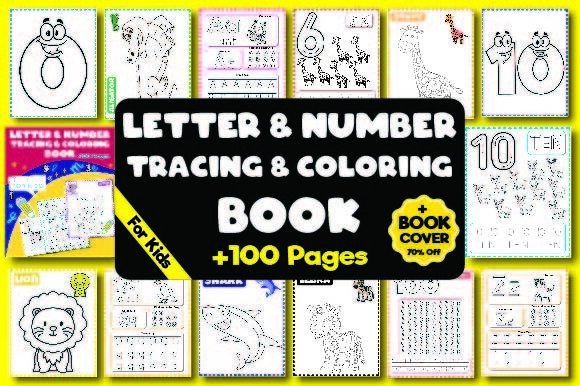
Pencil Control Tracing and Games Kids
First Impressions: Playful, Purposeful, and Precisely Designed for Tiny Hands
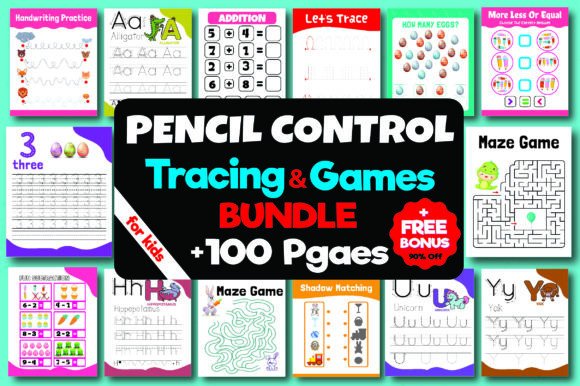
As someone who’s digitized over 200 embroidery files for preschool-themed apparel and nursery decor, I opened Pencil Control Tracing and Game s Kids expecting charm—but what stood out immediately was its quiet intentionality. This isn’t just “cute graphics”—it’s a cohesive visual system built around early learning rhythms: looping curves for letter ‘c’, dotted lines that invite tracing motion, numbered paths with gentle directional cues. The shapes are clean, the line weights consistent, and the spacing generous—not cramped or overly decorative. That matters immensely when translating to stitch. I pictured it instantly on a soft cotton baby sweatshirt: not as a busy all-over print, but as a single centered motif above a pocket—simple, legible, and full of warmth.
Where It Shines in Real Embroidery Projects
Pencil Control Tracing and Game s Kids thrives where clarity meets connection. Think embroidered tote bags for kindergarten orientation—stitched boldly across the front in navy thread on natural canvas, with a single traced number “5” or lowercase “a” as the anchor. Or custom tea towels for new teachers: a small, balanced cluster of three tracing arrows and a dotted “B” near the hem, stitched with matte cotton thread for tactile softness. As a machine embroidery design, it leans into running stitch outlines and open fill areas rather than dense satin coverage—making it forgiving on lightweight knits and ideal for baby embroidery where breathability and comfort are non-negotiable.
For Etsy sellers and craft business owners, this bundle works especially well as part of a themed digital embroidery file collection—paired with simple alphabet applique designs or minimalist growth-chart motifs. It also translates cleanly into printable mockups: sketch the design on a flat-lay photo of a linen pillow cover or a denim cap, and you’ll see how its friendly scale holds presence without overwhelming. Holiday embroidery? Try stitching “12” inside a traced snowflake outline on a felt stocking—subtle, seasonal, and educationally grounded.
What to Watch For: Texture, Scale, and Fabric Behavior
This isn’t a one-size-fits-all embroidery file. Its strength lies in simplicity—but that means small details need thoughtful execution. If you’re planning an embroidered patch using Pencil Control Tracing and Game s Kids, avoid shrinking any page below 2.5 inches wide; tiny dotted lines or fine tracing paths can vanish in fill stitch or blur on textured twill. On stretchy fabric like jersey tees or baby bodysuits, stabilize generously—lightweight cutaway works better than tear-away here, since the design often includes delicate directional strokes that shift if the base moves mid-stitch.
Dark fabric demands extra attention: test thread colors on scrap first. A pale yellow “3” may read beautifully on oatmeal linen but disappear on charcoal fleece unless you boost contrast with white underlay or switch to a brighter gold tone. And on curved surfaces—like caps or apron pockets—avoid placing intricate tracing sequences across seams or high-drape zones. Opt instead for bolder, isolated elements: a single traced star, a numbered path ending in a smiley face, or a clean “Zz” for naptime-themed items.
Design Integrity Meets Customer Trust
When your handmade product carries Pencil Control Tracing and Game s Kids, you’re not just selling embroidery—you’re signaling thoughtfulness. Parents recognize the pedagogical rhythm in those dotted lines. Teachers spot the alignment with early literacy standards. That builds quiet credibility, especially for boutique branding or personalized gifts. A custom embroidered baby blanket with a traced “1–10” sequence feels intentional, not generic—and that perception elevates perceived value, supports higher pricing, and encourages repeat buyers.
But authenticity hinges on execution. If stitch density is too high, the tracing lines lose their light, guiding quality and become stiff and graphic. If hoop size is undersized for the layout, corners get clipped or letters distort. Always inspect small lettering in your embroidery software before stitching—zoom in, check stitch direction on curves, confirm no overlapping vector nodes that could cause jump stitches. And never assume licensing covers commercial use: verify whether this Graphics bundle permits resale of finished embroidered items or digital embroidery file redistribution—especially if you’re building a craft business or listing on Etsy.
Practical Designer Notes You’ll Actually Use
- Test the design on scrap fabric matching your final project’s weight and stretch—especially for baby embroidery or custom apparel.
- Check thread color contrast on both light and dark backgrounds using black-and-white mockups (not just your screen’s RGB preview).
- Review stitch density: aim for balanced coverage—enough to define shape, not so much that tracing paths feel heavy or inflexible.
- Confirm hoop size compatibility before digitizing or stitching; some pages include wider layouts that exceed standard 4x4 hoops.
- Inspect small details—dots, arrowheads, and terminal loops—under magnification in your embroidery software.
- Use appropriate stabilizer: cutaway for knits, tear-away for stable wovens, and mesh for sheer fabrics.
- Ask yourself: does this work equally well for personal keepsakes *and* commercial embroidery projects? If not, adjust scale or simplify.
- Always verify license terms—Teaching Materials bundles sometimes restrict resale of physical products unless explicitly permitted.
Final Thought: Design That Grows With Its Purpose
Pencil Control Tracing and Game s Kids doesn’t shout. It invites. It guides. And in embroidery—where every stitch carries weight and meaning—that restraint is its greatest strength. Whether you’re stitching a holiday embroidery gift for a first-time teacher or building a signature line of educational toddler apparel, this bundle gives you clean, confident design assets that land softly but stay memorable. Just remember: great embroidery starts not with how it looks on screen, but how it behaves on fabric—and this one earns its place when treated with equal parts care and clarity.