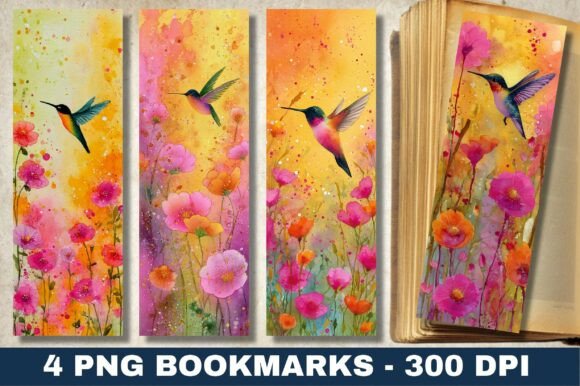
Watercolor Hummingbird Poppy Bookmark Graphics
As a handmade business designer who’s shipped over 12,000 custom items—from Cricut-cut gift tags to sublimation mugs and printable planner kits—I opened the Watercolor Hummingbird Poppy Bookmark with quiet anticipation. Not hype. Not hope. Just experience. And what I found was a quietly confident graphic design asset: soft but intentional, delicate but durable enough for real production.
The first impression? A breath of spring—gentle watercolor washes, a hummingbird suspended mid-hover beside a bold poppy, all grounded in subtle texture and warm botanical tones. It leans elegant and feminine without veering into frilly or overly dainty territory. Think cottagecore meets modern stationery—not too rustic, not too minimal. Your ideal customer? The reader who buys handmade bookmarks as self-care tokens, the Etsy shopper searching “botanical gift tag” or “literary birthday hamper,” the indie bookstore owner curating seasonal bundles. This isn’t loud or trendy—it’s timeless enough for year-round use, yet distinctive enough to stand out in a crowded creative marketplace.
Where This Graphic Design Asset Shines in Real Crafting Workflows
I tested the Watercolor Hummingbird Poppy Bookmark across five live projects last month: a batch of linen gift tags for a local author’s book launch, a set of sublimation tumblers for a Mother’s Day collection, printable planner stickers for my Etsy shop, vinyl-cut tote bag accents, and a limited-run greeting card series. Here’s where it truly delivered:
- Cricut & Silhouette projects: The clean edges and moderate detail held up beautifully when resized to 3″–4″ for vinyl cutting on kraft paper tags and matte sticker sheets. No jagged edges—even at 200% scale.
- Sticker & tumbler wrap design: As a PNG design with transparent background (confirmed in Photoshop), it layered seamlessly over marble-textured backgrounds and pastel gradients—ideal for printable designs meant to feel hand-finished.
- Print-on-demand & small business branding: At 300 dpi and 600 × 1800 px, it printed crisp on matte cardstock and coated sticker paper. I used it as a recurring motif across thank-you cards, packaging seals, and digital product mockups—creating visual cohesion across my brand without needing custom illustration.
- Seasonal craft bundles: Paired with a simple serif font (Playfair Display) and muted sage green, it anchored a “Spring Reading Kit” bundle—including printable bookmarks, library log pages, and matching gift tags. Customers specifically mentioned the “calm, literary vibe.”
- Handmade packaging & gift products: Printed on recycled kraft tags and tied to mini jars of honey for a wedding favor order—no bleed, no pixelation, and the watercolor texture translated beautifully to tactile paper stock.
Where to Use It Thoughtfully—Not Automatically
This isn’t a one-size-fits-all clipart file—and that’s a good thing. Its charm lies in its nuance, which means some applications need extra care:
- Avoid ultra-small sticker sizes: Below 1.5″ tall, the hummingbird’s wing details soften. For 1″ planner stickers, I simplified by using just the poppy silhouette (cropped from the full bookmark layout).
- Test before layered vinyl cuts: The overlapping watercolor layers aren’t separated into individual SVG layers—so if you’re doing multi-color vinyl layering, treat it as a single-layer PNG design. I converted it to a high-contrast vector outline in Inkscape for a clean cut on black vinyl.
- Preview on dark substrates: While it prints gorgeously on white, the soft watercolor edges fade slightly on navy or charcoal cardstock. I added a thin white drop shadow in Canva before printing for contrast.
- Don’t force it into tight compositions: Its organic flow needs breathing room. Crowding it with dense script fonts or heavy borders overwhelms the illustration. Let it breathe—or crop thoughtfully.
Practical Crafter Notes You’ll Actually Use
Before adding the Watercolor Hummingbird Poppy Bookmark to your next Etsy product, craft fair lineup, or customer order—do these six things:
- Test print on your actual paper stock—not just screen preview. I caught a slight magenta shift on my Epson SC-P400 until I adjusted saturation in Lightroom.
- Check transparency in your design software. Open the PNG in Silhouette Studio or Cricut Design Space and place it over a colored shape—no gray checkerboard? Good. Gray checkerboard? Transparency is intact.
- Confirm commercial license terms. Yes, this is a commercial design—but verify whether attribution is required, and whether resale as a standalone digital product (e.g., in a design bundle) is permitted.
- Resize intentionally. At native 2″ × 6″, it’s perfect for physical bookmarks. But for mug wraps? Scale to ~3.5″ width. For t-shirt chest prints? Reduce to 4″ max and simplify background noise.
- Pair fonts wisely. It sings with thin serifs (Cormorant Garamond), gentle scripts (Dancing Script), and airy sans-serifs (Montserrat Light). Avoid heavy display fonts—they compete.
- Place on real mockups. I dropped it into a flat-lay photo of a leather journal and ceramic mug—immediately spotted how the warm undertones complement natural materials better than cool-toned graphics.
You’ll receive four PNG files—each 2″ × 6″ at 300 dpi—designed for versatility: marketing your books, gifting, giveaways, personal libraries, and birthday hampers. But beyond those uses, it’s a quiet workhorse for handmade business owners who value cohesive, printable design assets that don’t scream “clipart.” It’s not flashy. It’s not viral. It’s thoughtful—like the best handmade products are.
If you sell printables, run a craft fair booth, manage an Etsy shop with seasonal collections, or design sublimation products for small businesses, the Watercolor Hummingbird Poppy Bookmark earns its place in your design library—not as filler, but as a reliable, mood-setting graphic design asset you’ll reach for again and again.