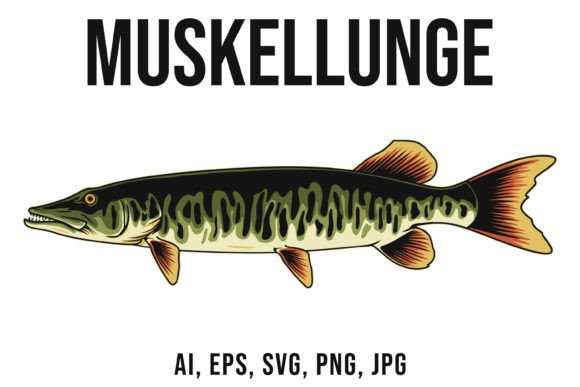
Muskellunge Fish Vector Drawing
As a designer who’s stitched over 300 custom embroidery projects—from boutique baby onesies to Etsy best-selling tote bags—I opened the Muskellunge Fish Vector Drawing file expecting something clean and fish-themed. What I got was sharper: a confident, retro-leaning silhouette with strong visual rhythm and quiet personality. It doesn’t scream “sporty” or “cartoonish.” It breathes wildness—lean, streamlined, subtly powerful—like a muskie gliding just under the surface. That tone matters more than you’d think when translating vector to thread.
First Stitch, First Impression: Does It Feel Handmade—or Just Printed?
I pulled up the SVG first (vector clarity is non-negotiable for resizing), then dropped it into my digitizing software to preview stitch behavior. The outline is smooth but not overly simplified—it holds enough character in the tail curve and head taper to read as muskellunge, not generic pike. No tiny gills, no cluttered scales, no forced realism. That’s a win. For embroidery, less detail often means better definition—especially on textured fabrics like canvas tote bags or terry cloth tea towels.
I mocked it up on a navy sweatshirt: black thread, medium-density fill. Instantly, it landed with weight and intention—not flashy, but unmistakably *crafted*. Customers browsing your small shop or Etsy listing won’t pause because it’s loud. They’ll pause because it feels intentional, grounded, quietly cool. That kind of restraint builds trust. It says, “This wasn’t auto-generated. Someone chose this shape for a reason.”
Where It Shines—and Where It Asks for Thought
The Muskellunge Fish Vector Drawing thrives in projects where mood and identity matter more than motion or narrative. Think:
- Embroidered patches for fishing clubs or outdoor gear brands—its clean lines hold up beautifully after cutting and heat-sealing;
- Tote bag designs for local bait shops or conservation nonprofits—works equally well solo or paired with minimal text;
- Baby embroidery on organic cotton onesies—soft, symbolic, gender-neutral, and far from cliché;
- Kitchen towel or apron accents for cottage-core or lake-house themed boutiques—retro enough to feel nostalgic, simple enough to stay timeless;
- Holiday or wedding gifts for anglers or nature lovers—a muskie isn’t expected. That surprise factor makes it memorable.
But let’s be real: it’s not a one-size-fits-all embroidery file. Its strength—clean, continuous outline—is also its limit. On stretchy fabric like jersey tees? You’ll need cutaway stabilizer and possibly a satin-stitch border to lock down edges. On dark fabric? Avoid light thread unless you’re adding underlay—fill stitch density must support contrast. And if you’re planning dense applique with layered fabrics (say, a quilted pillow cover), test how the fish’s tapered tail reads at 2.5 inches tall—some digitizers compress fine points too aggressively.
What It Adds to Your Craft Business—Beyond the Stitch
For Etsy sellers and small shop owners, the Muskellunge Fish Vector Drawing isn’t just another graphic. It’s a subtle brand amplifier. When used consistently—on packaging, digital mockups, social posts, even embroidered hang tags—it builds recognition without shouting. It signals niche awareness: you understand fishing culture, regional wildlife, and the quiet pride of the outdoors. That resonates with buyers who scroll past mass-produced logos.
It also elevates perceived value. A hand-embroidered muskie on a linen tea towel reads more artisanal than a printed trout. Why? Because the shape invites careful stitching—moderate curves, balanced negative space, clear hierarchy between body and tail. That translates to cleaner finished products, fewer re-dos, and happier customers leaving five-star reviews about “quality details.”
Practical Designer Notes Before You Stitch
Before loading this into your machine or listing it as part of a digital embroidery file bundle, do these five things:
- Test on scrap fabric that matches your final project—canvas, fleece, cotton poplin, or whatever you’re using. Watch how the tail point lands. Does it feather? Pucker? Adjust underlay if needed.
- Check thread color contrast in both light and dark mockups. This design relies on silhouette—so if your navy thread disappears on charcoal fabric, go deeper or add white underlay.
- Review stitch density in the body fill. Too dense = stiff fabric; too sparse = gaps. Aim for 4–5 stitches/mm for most apparel and home goods.
- Confirm hoop size compatibility. If you’re stitching caps or curved surfaces, verify whether the original vector scales cleanly down to 3.5" wide without losing legibility.
- Verify licensing. Since this is listed as a Graphics product in Crafts, confirm whether commercial use—especially resale of finished embroidered items or inclusion in digital embroidery bundles—is permitted. When in doubt, contact the creator before scaling for your craft business.
Final Thought: It’s Not Just a Fish—It’s a Vibe Anchor
In a market flooded with generic fish icons and over-digitized marine motifs, the Muskellunge Fish Vector Drawing stands out by doing less. Its power lies in what it omits: no bubbles, no water ripples, no cartoon eyes. Just form, function, and quiet confidence. That makes it unusually versatile—not for every project, but for the right ones. The ones where authenticity matters more than volume. The ones your customers remember, not because it’s loud, but because it feels true.
If you’re curating design assets for a growing craft business—or simply choosing your next embroidered patch, sweatshirt, or personalized gift—the Muskellunge Fish Vector Drawing earns its place not as filler, but as a deliberate, grounded choice. One that stitches well, sells thoughtfully, and stays quietly distinctive long after the hoop comes off.