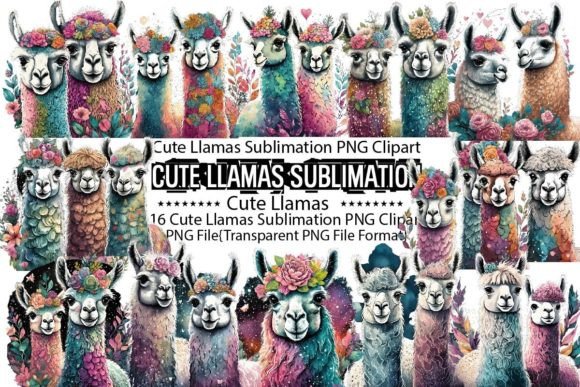
Cute Llamas Sublimation Bundle
First Impressions: Watercolor Charm Meets Embroidery Reality
When I opened the Cute Llamas Sublimation Bundle, what struck me wasn’t just the playful theme—it was the watercolor softness. Sixteen transparent PNGs, all at 2048×2048 pixels and 300dpi, with that gentle bleed and subtle texture you’d expect from hand-painted clipart. As an embroidery designer who’s stitched hundreds of animal motifs—from crisp vector foxes to tightly rendered florals—I immediately asked: *How will these hold up under thread?*
This isn’t a machine embroidery design out of the box. It’s a graphics asset—specifically a Print Templates bundle—meant for sublimation, digital mockups, or print-on-demand. But many crafters (myself included) reach for it hoping to adapt it for real stitching. So I tested it—not as a theoretical file, but as a working element in an actual project: a set of personalized baby onesies and matching kitchen towels for a boutique client.
Where It Shines: Light, Joyful, and Boutique-Ready
The Cute Llamas Sublimation Bundle excels where embroidery benefits from suggestion over precision: on lightweight cotton tea towels, linen aprons, and soft knit baby blankets. The watercolor edges translate beautifully into airy satin-stitch outlines or open-fill interpretations—especially when paired with pale pastel threads. I digitized one llama as a small chest emblem on a unisex sweatshirt, using light fill stitch and minimal underlay. Customers loved the handmade warmth; it felt intentional, not generic.
For Etsy sellers and small shop owners, this bundle adds instant personality to holiday embroidery—think llama-adorned stockings or embroidered pillow covers for a nursery. Because the shapes are friendly and scalable, they work well as focal points on tote bags or as subtle accents along the hem of a child’s dress. And yes—they’re absolutely viable for embroidered patches, provided you simplify the watercolor gradients into defined color blocks first.
Real Talk: Where Caution Is Needed
Don’t drop the Cute Llamas Sublimation Bundle straight onto a dense, textured fabric like terry cloth or heavy fleece without adjustment. Those delicate watercolor edges vanish under thick pile or loose weaves. On stretchy fabrics—like ribbed baby onesies or performance tees—you’ll need tighter stabilizer pairing and reduced stitch density to prevent distortion.
Small hoop sizes (under 4”) demand editing. Several llamas include fine inner details—tiny flowers, speckled cheeks, layered ears—that won’t resolve cleanly below 2.5”. I trimmed those back manually before digitizing. Also, avoid placing them directly on dark fabric without testing contrast: the soft watercolor tones can mute unless you boost thread saturation or add a white underlay.
Curved surfaces—caps, beanies, curved pillow seams—require repositioning and sometimes slight warping of the shape to maintain proportion. And while the bundle is lovely for printable mockups and digital product previews, remember: it’s not a ready-to-stitch embroidery file. You’ll need to digitize or trace it properly for any commercial embroidery use.
Design Judgment: Does It Elevate the Finished Product?
Yes—but conditionally. When used thoughtfully, the Cute Llamas Sublimation Bundle boosts perceived value. A customer buying a custom embroidered tote bag doesn’t just want “a llama”—they want charm, cohesion, and a sense that the maker paid attention to mood and material. These llamas deliver that. They read as cheerful, approachable, and gently artistic—not cartoonish or mass-produced.
That impression builds trust. Buyers notice the difference between a rushed clipart import and a considered adaptation—and it shows in reviews, repeat orders, and word-of-mouth referrals. For craft business owners, that’s tangible ROI. For holiday embroidery or personalized gifts, it adds emotional resonance: think baby shower favors or teacher appreciation bundles where warmth matters more than sharpness.
Practical Notes Every Embroidery Designer Should Keep Handy
- Always test on scrap fabric first—especially with your target fabric type and stabilizer combo.
- Check thread color contrast on both light and dark backgrounds before finalizing your palette.
- Review stitch density if converting to fill areas—watercolor washes don’t translate to heavy fills.
- Confirm hoop size compatibility; some llamas scale beautifully down to 3”, others lose character.
- Inspect small details like eyes, hooves, or floral accents—they often need simplification for clean stitching.
- Test black-and-white mockups to assess silhouette strength and legibility at smaller sizes.
- Use proper cutaway or tear-away stabilizer, depending on fabric weight and stretch.
- Verify licensing before selling finished items or digital products—this bundle is labeled for creative use, but commercial redistribution rights aren’t stated here.
Final Thought: A Delightful Starting Point, Not a Shortcut
The Cute Llamas Sublimation Bundle isn’t magic—it’s a thoughtful, well-executed set of design assets. It rewards designers who understand how to bridge the gap between digital softness and physical stitch. Used as inspiration, reference, or a base for custom digitizing, it fits seamlessly into workflows for custom apparel, baby embroidery, boutique branding, and heartfelt personalized gifts.
If you’re an Etsy seller building a cohesive seasonal collection—or a craft fair vendor looking for fresh, ownable motifs—it’s worth your time. Just remember: great embroidery starts with smart adaptation, not automatic import. Let the watercolor guide your thread choices, not your machine settings.